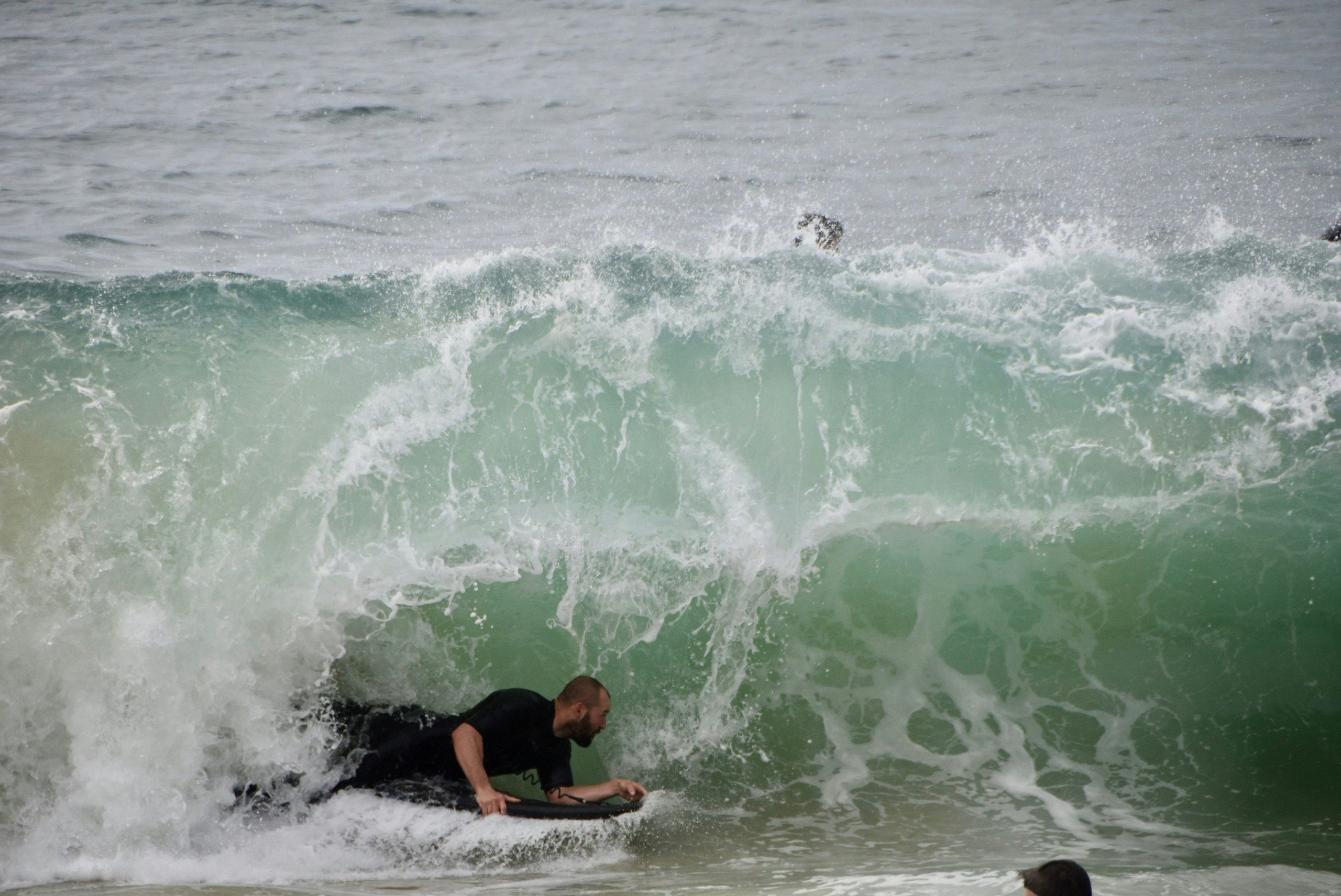
Beneath the surface of La Jolla lies a massive underwater canyon that helps shape one of California’s most powerful and fascinating surf breaks.
SHOREY™ | Surf Science · San Diego, California
Most surfers look at the swell forecast, check the wind and study the tide. But at Black’s Beach in San Diego, there’s another major player working beneath the surface: the Scripps Submarine Canyon.
This enormous underwater geological feature helps explain why Black’s can produce waves that are significantly more powerful than those at nearby beaches. It’s not just about how much swell is arriving from the Pacific. It’s also about what happens to that swell as it travels across the ocean floor.
Think of the Grand Canyon, except underwater. Instead of towering rock walls above the surface, Scripps Canyon is a deep underwater valley cutting through the continental shelf just offshore of La Jolla.
And for surfers, that geography makes all the difference.
The Canyon: An Underwater Wave Machine
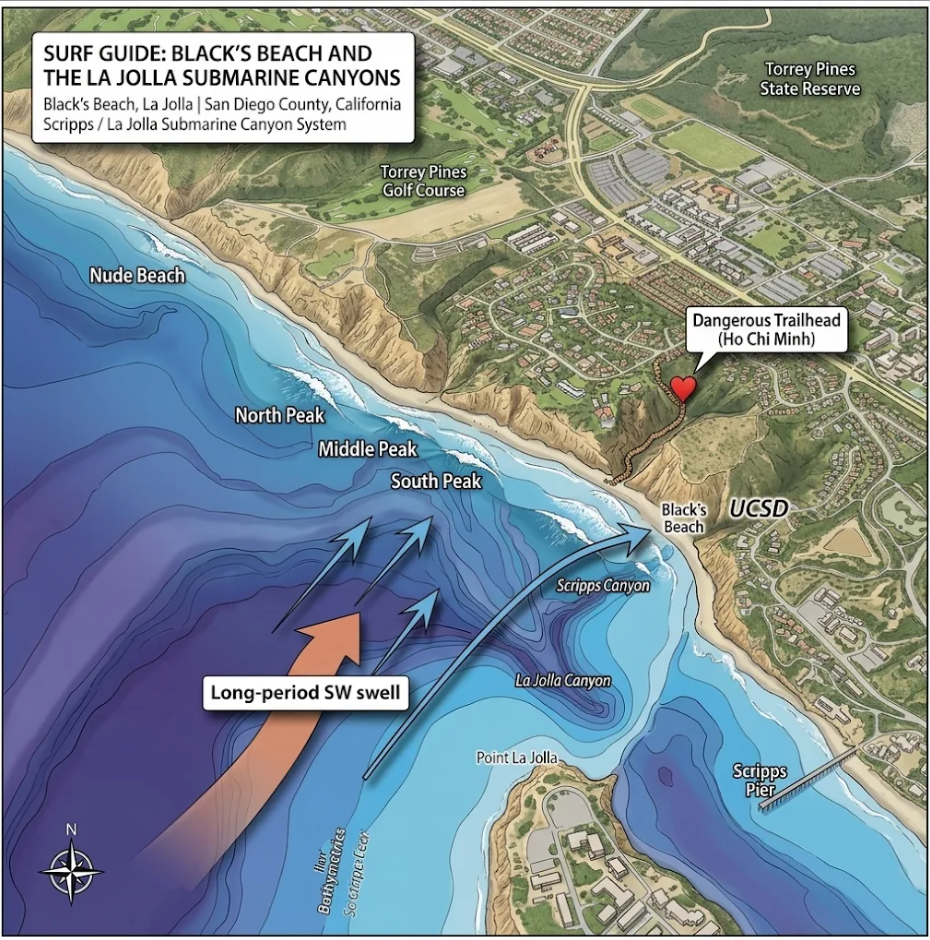
Scripps Submarine Canyon creates a dramatic change in ocean depth just offshore. The canyon has steep underwater walls, deep channels and surrounding areas of considerably shallower continental shelf.
When incoming Pacific swell encounters this underwater landscape, something fascinating happens.
Waves travel at different speeds depending on water depth. Over the deep canyon, waves can travel faster than they do over the surrounding shallow seabed. This difference in speed causes incoming wave crests to bend, a process known as wave refraction.
Imagine a straight line of incoming swell approaching an underwater valley. The portion of the wave traveling over the deeper canyon advances faster, while the portions traveling over shallower ground slow down.
The result is a bending and redistribution of wave energy.
It’s almost as if the ocean floor is reshaping the swell before it ever reaches the beach.
Why Black’s Can Get Bigger Than Its Neighbors
Here’s where things get particularly interesting.
The Scripps Canyon system can create areas where incoming wave energy converges and other areas where it spreads apart.
Research around the canyon has demonstrated that wave energy can become focused toward the northern side of the canyon, near Black’s Beach, while areas farther south can experience reduced wave energy.
This process helps explain why Black’s can receive powerful, concentrated swell while nearby stretches of coastline experience noticeably different conditions.
It’s important to understand that the canyon doesn’t automatically make every wave bigger. It redistributes incoming energy, creating localized areas of focusing and wave-energy shadowing.
Under the right swell direction and period, that focusing can contribute to some seriously impressive surf.
The Power of Long-Period Groundswell
Not all swell interacts with the canyon in the same way.
Long-period groundswell is particularly interesting because its energy can begin interacting with the ocean floor farther offshore.
As these waves approach the continental shelf, the changing depths influence their speed and direction. The canyon’s underwater walls can therefore play a significant role in how the swell is refracted and distributed.
Research around Scripps Canyon has identified particularly strong refraction effects for certain longer-period swell conditions.
For Black’s, this makes swell direction and period just as important as the forecast wave height.
A powerful northwest groundswell can interact with the canyon differently than a shorter-period wind swell or a swell arriving from another direction.
It’s one reason why watching the offshore forecast alone doesn’t always tell the whole story.
The Other Side of the Canyon: Currents and Rips
The underwater geography doesn’t just influence wave size. It also contributes to the complicated water movement around Black’s.
Differences in breaking-wave energy can create variations in water levels and circulation patterns along the beach.
Combined with the canyon, shifting sandbars and shoreline shape, these processes can contribute to:
- Powerful alongshore currents
- Localized rip currents
- Changes in where waves break
- Areas of concentrated water movement
- Dramatically different conditions between neighboring peaks
This is part of what makes Black’s such a challenging surf environment. The same underwater geography that helps shape its waves also contributes to the complexity of the lineup.
The SHOREY™ Take: The Ocean Floor Is Part of the Break
Black’s Beach isn’t simply a beach that happens to receive powerful Pacific swell.
It’s a fascinating example of how underwater geology, ocean depth and wave physics work together to shape a surf break.
The Scripps Submarine Canyon acts as a natural wave-energy redistributor. Its deep channels and steep underwater slopes influence how incoming swell travels toward the coastline, creating areas of convergence and divergence.
That means two beaches relatively close together can experience dramatically different surf conditions under the same offshore swell.
For surfers, it’s a reminder that there’s a whole world beneath the surface influencing what happens above it.
The wave starts forming long before it reaches the sand.
SHOREY™
For the love of waves, shorebreak, and everything in between.
Respect the ocean. Understand the break. Ride what the ocean gives you.
Cover photo: Alex Beattie on Unsplash